
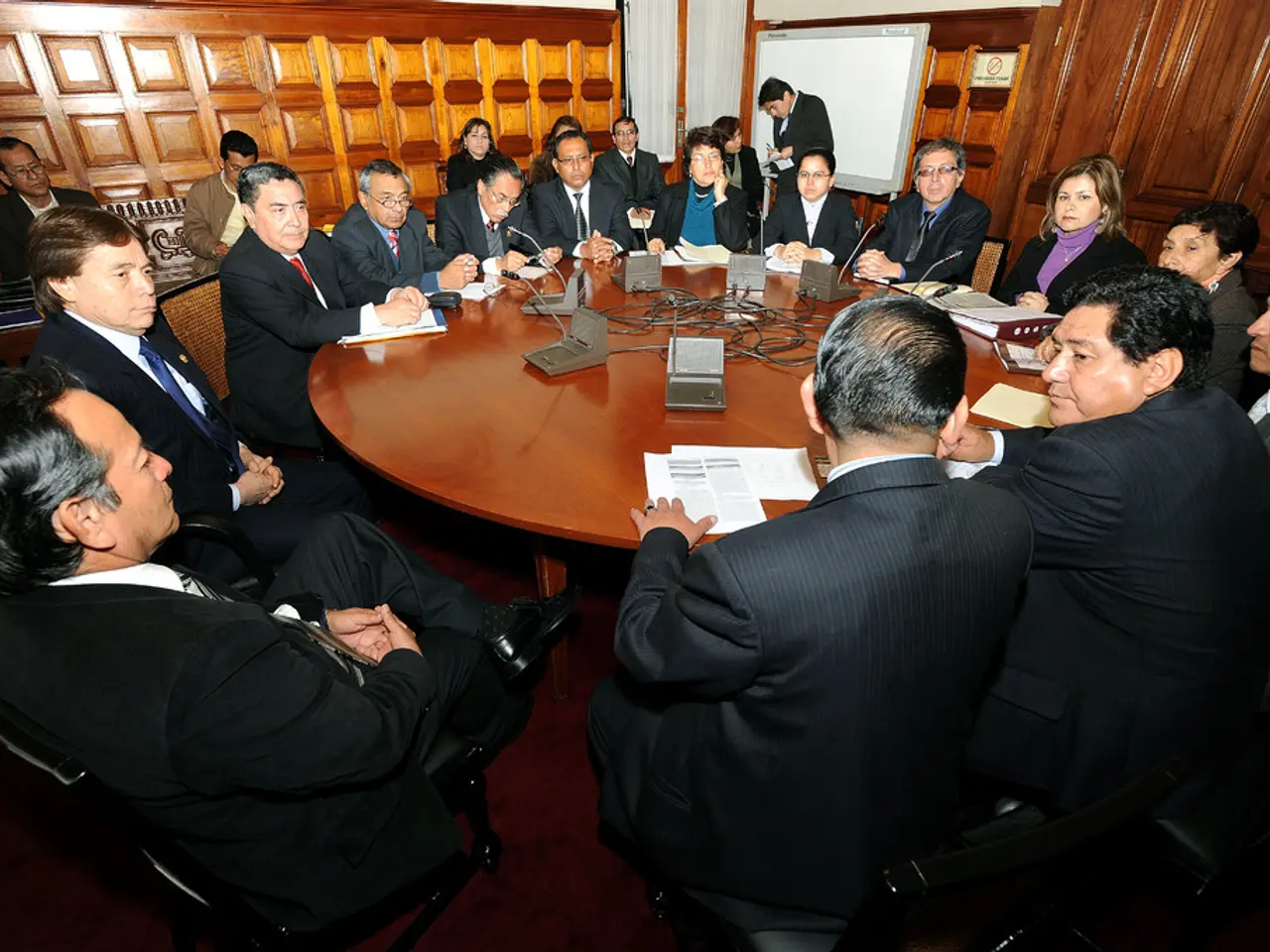
Four German managers found ways to involve Angela Merkel, the Chancellor, in their presentations or events. - Event or performance?
**German Chancellor Hosts High-Level Economic Roundtable**
Last Monday afternoon, German Chancellor Friedrich Merz welcomed four esteemed managers to his home for a private roundtable discussion, marking a significant step in his efforts to revitalize the nation's economy. The roundtable, which focused on economic policy matters, was attended by Jenny von Zepelinand, Thomas Steinmann, Timo Pache, and Julius Betschka.
The event, titled a "high-level economic roundtable," was a four-manager draft, with Merz himself leading the proceedings. The discussion revolved around the importance of sustainable economic growth, investment in digital infrastructure, and the need to foster technological advancements such as artificial intelligence, quantum computing, and climate-neutral energy.
Julius Betschka emphasized the significance of sustainable economic growth, while Jenny von Zepelinand spoke about the importance of a stable economic environment for businesses. Timo Pache highlighted the need for investment in digital infrastructure to boost the economy, and Thomas Steinmann expressed concerns about the potential impact of inflation on the German economy.
During the roundtable, the managers shared their insights and perspectives, with Merz encouraging productive dialogue. The event concluded with a group discussion on the proposed economic strategies. It's worth noting that no specific decisions or agreements were announced following the roundtable.
This roundtable marked a strategic move in Merz's efforts to foster a public-private partnership aimed at overcoming recent economic challenges and positioning Germany for future growth. The roundtable was part of the broader Investment Summit, which brought together executives from about 60 major German companies, representing roughly a third of the German economy.
The Investment Summit, launched to revive Germany’s economy after two years of recession, was a high-profile event focused on rallying fresh investment. The nature of the event was to launch the "Made for Germany" initiative, a massive investment campaign where these companies pledged to invest a combined total of €631 billion over the next three years. The investments are targeted at expanding production facilities, machinery, equipment, research and development, and fostering technological advancements.
The goal is to strengthen Germany’s competitiveness, reboot its status as a European economic powerhouse, and support growth amid global economic challenges. Chancellor Merz emphasized that Germany is once again an attractive destination for investment, framing the event as one of the largest investment initiatives in decades and highlighting private sector engagement as vital alongside public investments like the €500 billion infrastructure and climate fund recently approved by his administration.
In summary, the high-level economic roundtable hosted by Chancellor Friedrich Merz was a strategic move in his efforts to foster a public-private partnership aimed at overcoming recent economic challenges and positioning Germany for future growth. The roundtable brought together four esteemed managers, each contributing valuable insights to the discussion on sustainable economic growth, investment, and technological advancement. The roundtable was part of the broader Investment Summit, which aims to revive Germany’s economy by rallying fresh investment and launching the "Made for Germany" initiative, a massive investment campaign worth €631 billion over the next three years.
The roundtable discussion, while focusing on sustainable economic growth and investment in digital infrastructure, also emphasized the importance of community and employment policies to foster technological advancements such as artificial intelligence, quantum computing, and climate-neutral energy. Chancellor Merz underlined the significance of finance and investing as key components of the "Made for Germany" initiative, which invites businesses to invest €631 billion over the next three years, supporting Germany's competitiveness and positioning it as a European economic powerhouse.




