
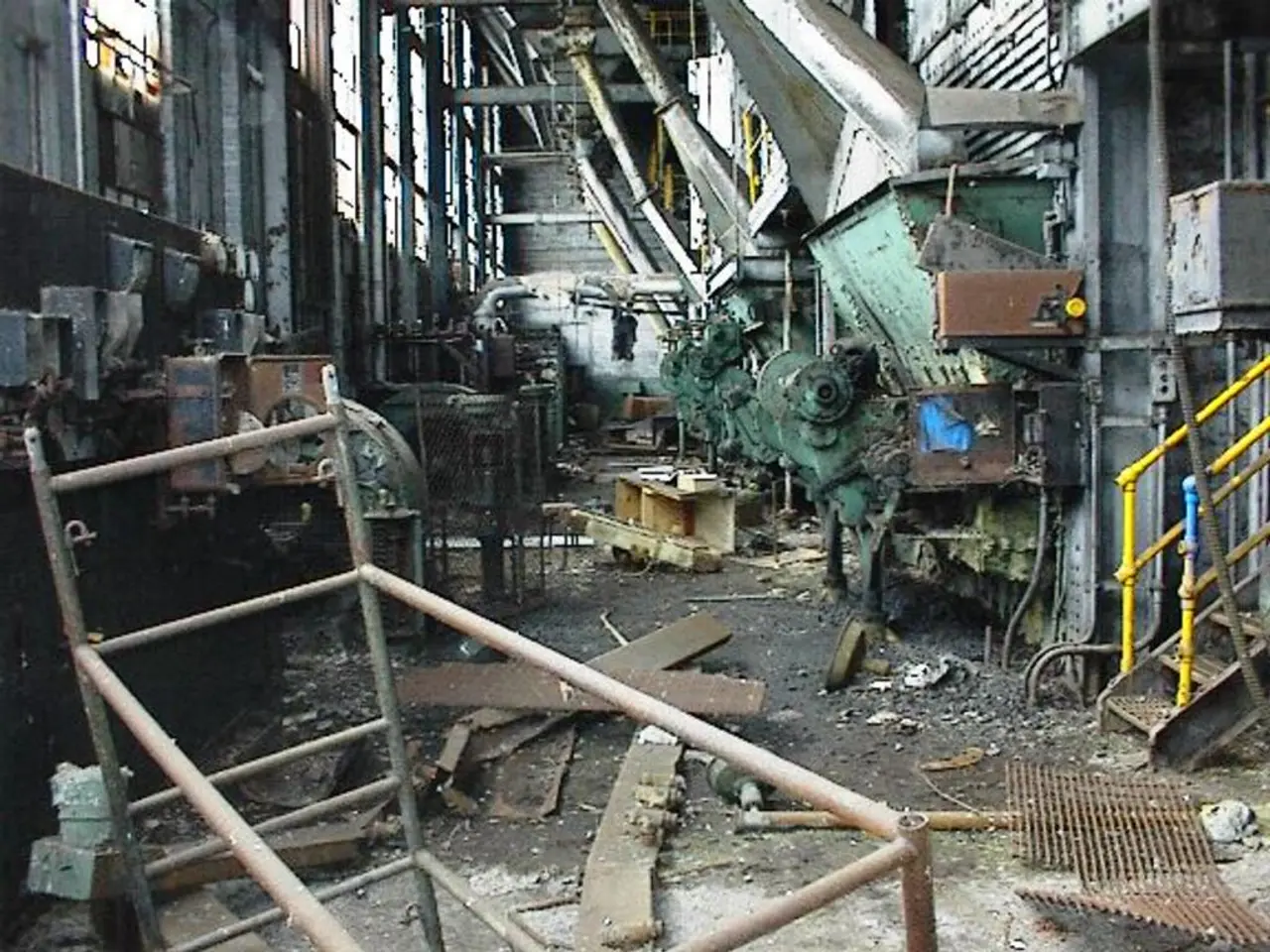
Factory production in Germany reaches record low since the onset of the Covid-19 pandemic
Germany, a nation renowned for its export-driven economy, is currently grappling with the impact of increased US tariffs on EU exports. The tariffs, set at a 15% rate under the 2025 US-EU trade deal, have caused significant concerns for key sectors such as automotive, mechanical engineering, chemicals, pharmaceuticals, and metals [1][3][4].
The new tariffs have raised costs for German exports to the US, eroding price competitiveness and reducing demand for German goods in the US market [2][4]. This has led to a sharp decline in German economic confidence and growth outlooks amid increasing export costs and competitiveness challenges.
The economic sentiment indicator (ZEW) fell by 18 points in August 2025, reflecting disappointment among financial experts about the trade deal and concerns over Germany’s weak second-quarter performance. This drop highlights increased uncertainty and negative expectations for growth in the near term [3].
Key industrial sectors—chemical, pharmaceutical, mechanical engineering, metal, and automotive industries—are particularly affected by the tariffs, experiencing severe burdens that could dampen output and employment linked to exports [3][4].
The combination of tariffs and a stronger euro further undermines German export competitiveness in the US market, exacerbating the challenges created by shifting global economic conditions and trade tensions [4].
While the broader EU economy is expected to experience a modest GDP decline of about 0.2% to 0.8%, countries with significant US export volumes like Germany will be disproportionately impacted [4].
However, some moderation in negative effects is anticipated due to resilience factors such as the US’s robust consumption supported by strong stock market performance and Europe's ongoing fiscal and monetary support measures [4][5].
The US investigations into sectors including pharmaceuticals and semiconductor equipment have caused further concerns about potential further negative impacts [6]. The federal statistics agency Destatis revised May industrial production data, showing a 0.1% decrease instead of a 1.2% increase, adding to the concerns [7].
Industrial orders in Germany decreased by 1.0% month-on-month in June, following a 0.8% decrease in May, and factory output decreased by 1.9% month-on-month, steeper than the forecasted 0.5% drop [8]. German exports to the US in June decreased by 2.1%, while worldwide exports increased by 0.8% [9].
Helena Melnikov, the head of the German chambers of commerce, stated that the tariffs are a big burden for German companies [10]. Carsten Brzeski, an analyst at ING bank, stated that the dire data could lead to a downward revision of the economic growth estimate for the second quarter [11].
Despite these challenges, plans for infrastructure upgrades and rearmament in Germany had raised hopes of economic recovery, but hard data on business activity has been disappointing [12]. The new tariffs could potentially have a significant impact on Germany, which has traditionally been an export powerhouse [13].
References:
[1] Reuters. (2025, August 31). US tariffs hit German industry, exports, as economic sentiment slumps. Retrieved from https://www.reuters.com/business/us-tariffs-hit-german-industry-exports-as-economic-sentiment-slumps-2025-08-31/
[2] Handelsblatt Global. (2025, August 31). US tariffs on EU goods: What you need to know. Retrieved from https://www.handelsblatt.com/global/story/20250831/us-tariffs-on-eu-goods-what-you-need-to-know/
[3] Financial Times. (2025, August 31). German economic sentiment indicator slumps on US trade deal disappointment. Retrieved from https://www.ft.com/content/c322e58c-6e1e-4040-837c-3415d3bb8b4d
[4] Deutsche Welle. (2025, August 31). US tariffs on EU goods: What do they mean for Germany? Retrieved from https://www.dw.com/en/us-tariffs-on-eu-goods-what-do-they-mean-for-germany/a-57893325
[5] Bloomberg. (2025, August 31). US Tariffs on EU Goods Could Hurt German Economy More Than Thought. Retrieved from https://www.bloombergquint.com/global-economics/us-tariffs-on-eu-goods-could-hurt-german-economy-more-than-thought
[6] Politico. (2025, August 31). US probes EU pharmaceutical, semiconductor sectors in trade dispute. Retrieved from https://www.politico.eu/article/us-probes-eu-pharmaceutical-sector-in-trade-dispute/
[7] Destatis. (2025, September 1). Revised May 2025 industrial production data. Retrieved from https://www.destatis.de/EN/Themes/Industry/Production/Production/IndustrialProduction/IndustrialProductionData/IndustrialProductionData.html
[8] Statista. (2025, September 1). German industrial orders. Retrieved from https://www.statista.com/statistics/1118680/german-industrial-orders/
[9] Federal Statistical Office of Germany. (2025, September 1). German exports and imports. Retrieved from https://www.destatis.de/EN/Themes/Industry/Production/ForeignTrade/ForeignTradeData/ForeignTradeData.html
[10] Reuters. (2025, August 31). German industry struggles with US tariffs, weak demand. Retrieved from https://www.reuters.com/business/us-tariffs-hit-german-industry-as-demand-weakens-2025-08-31/
[11] Reuters. (2025, August 31). German economy to shrink in Q2, as industry slumps and trade tensions rise. Retrieved from https://www.reuters.com/business/german-economy-shrink-q2-as-industry-slumps-and-trade-tensions-rise-2025-08-31/
[12] Financial Times. (2025, August 31). Germany's economic recovery falters as industrial slump deepens. Retrieved from https://www.ft.com/content/7b826c5c-d06d-4f07-9224-0f3b2017140c
[13] Deutsche Welle. (2025, August 31). US tariffs on EU goods: What do they mean for Germany? Retrieved from https://www.dw.com/en/us-tariffs-on-eu-goods-what-do-they-mean-for-germany/a-57893325
The increased US tariffs under the 2025 US-EU trade deal have caused significant concerns for key German sectors, such as chemicals, pharmaceuticals, mechanical engineering, metals, and automotive industries, potentially affecting output and employment linked to exports [3][4]. The new tariffs, along with a stronger euro, erode the competitiveness of German exports in the US market, creating challenges for these industries [4]. These problems have led to declines in economic confidence and growth outlooks in Germany, as reflected in the drop of the economic sentiment indicator by 18 points in August 2025 [3].




